There is a particular kind of Witch who does not seek magick merely to change the world around her. She seeks to see. To know what lies beneath appearances.
To listen to what cannot be heard with ordinary ears. To walk into the places where the boundaries between worlds become thin.
This is where the figures of Óðinn, Freyja, seiðr and the Fylgja become so important. Together they open a door into one of the most mysterious aspects of the old Norse magickal imagination:
the relationship between the human being and the unseen world.
Óðinn —
The Seeker of Hidden Knowledge
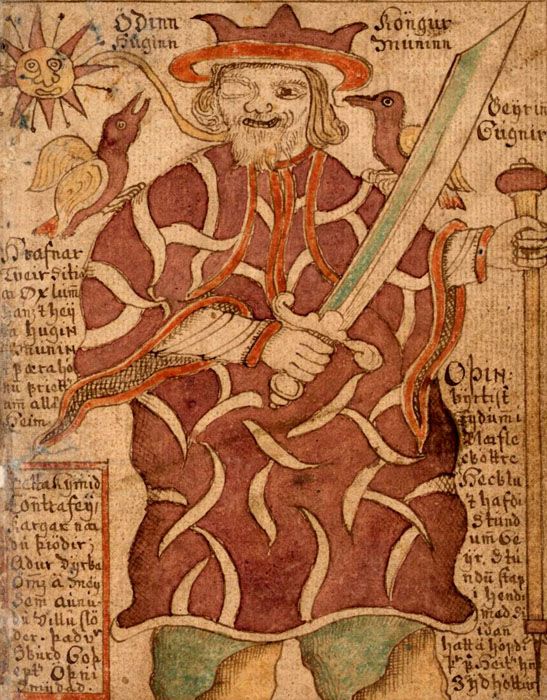
Óðinn is often remembered as a god of war. But that is only one part of him. He is also the seeker. The wanderer. The magician.
The god who sacrifices comfort, certainty and even part of himself in the pursuit of knowledge.
In Ynglinga saga, Óðinn is described as possessing many magickal abilities. He could change his shape, travel beyond his physical body, work with spells and songs, communicate with the dead and gain knowledge of things hidden from ordinary sight.
This makes Óðinn an extraordinarily interesting figure for anyone studying witchcraft. He does not represent passive wisdom.
He represents knowledge that must be pursued. He travels for it. He suffers for it. He sacrifices for it. And sometimes he enters places where others would be afraid to go.
This is one of the great lessons of Óðinn: Wisdom has a price. The deeper we go into the unseen, the more responsibility we carry for what we discover there.
Seiðr — The Art of Seeing
Among the magical traditions associated with the Norse world, seiðr is perhaps one of the most fascinating.
The sources connect seiðr with prophecy, altered states, influencing events and interaction with forces beyond ordinary human perception.
And here we encounter one of the great paradoxes surrounding Óðinn. He is a master of magick. Yet the practice of seiðr was also associated strongly with women and with Freyja.
The Ynglinga saga says that Freyja taught the Æsir the magickal art practiced among the Vanir. The same account describes Óðinn as possessing extensive magickal knowledge, including knowledge of fate and spells.
In Lokasenna, Loki even mocks Óðinn for practicing magickal arts associated with women. The insult is important because it tells us something about the social boundaries surrounding magick.
Magick could be powerful. But power did not necessarily fit comfortably into the expectations placed upon men and women. Óðinn crossed that boundary. And he did so knowingly.
Freyja — Mistress of Seiðr
If Óðinn is the relentless seeker of hidden knowledge, Freyja is one of the great embodiments of magickal power itself.
She belongs to the Vanir and is associated with love, beauty, fertility, wealth and desire — but reducing her to these things would be a great mistake.
Freyja is also a powerful magickal figure. According to Ynglinga saga, she was the one who taught the Æsir the magickal art of the Vanir. There is something beautiful in this image.
A goddess teaches the gods. The knowledge comes from outside their original tradition. The powerful become students. And the teacher is a woman.
For a Witch, Freyja can therefore represent a very different kind of power from the warrior archetype. Her power does not require her to become less feminine.
She does not have to abandon beauty in order to become formidable. She does not have to choose between sensuality and wisdom.
Between tenderness and ferocity. Between love and sovereignty. She contains contradictions. And perhaps that is precisely what makes her powerful.
The Fylgja —
The Spirit Who Walks Beside You
And then we come to something much more intimate. The Fylgja. The word is generally understood in connection with something that accompanies or follows a person.
In Old Norse literature, fylgjur can appear as spirit companions or animal forms associated with individuals and families. Modern scholarship often describes them as personal spirit doubles, companions or manifestations connected with fate.
The fylgja is therefore very different from a distant deity. It is close. It belongs to the person’s spiritual landscape. It may appear in dreams. It may take an animal form.
It may be perceived as a presence. And sometimes its appearance carries a warning. The fylgja reminds us that the old Norse understanding of the person was not necessarily limited to the physical body.
A person could have a spiritual aspect that moved alongside them. A shadow-self. A companion. A guardian. A reflection of something deeper.
The Witch and Her Fylgja
For a modern Witch, the idea of the fylgja can become a powerful way of understanding the relationship between the practitioner and the spirit world.
The Witch does not necessarily walk alone. There may be animals that repeatedly appear in dreams. There may be certain beings or presences that return throughout a lifetime.
There may be an animal whose symbolism seems to follow the Witch through periods of transformation. And sometimes the relationship feels less like choosing a spirit animal and more like recognising someone who was already there.
This distinction matters. The Witch does not simply announce:
“This is my animal.”
She listens. She observes. She waits. The relationship develops through experience.
The Wolf
And this brings us back to the wolves. The wolf has become one of the strongest spiritual presences within the Witch’s journey. There is Fenrir.
There are the great wolf-kin who answer his call. And there is the possibility that the wolf can also be understood through the ancient idea of the fylgja — not because every wolf encountered in a spiritual experience must automatically be called a fylgja, but because the old concept gives us a language for thinking about an animal presence that accompanies a person.
A wolf can represent instinct and the ability to survive beyond the boundaries created by civilisation.
For this Witch, the wolves are not merely symbols. They are part of a relationship. They watch. They accompany. And when danger comes, Fenrir may call the others. The pack gathers.
I could not understand that real giant wolves had gathered in my home. They were very hungry and Fenrir and Hel warned me to sit silently and watch.
Then I shapeshifted into a giant wolf and I was very surprised at my ability to do so. The wolf Fennrir has possessed me to be together with me.
This is how you walk between the worlds together with your favourite spirits. I even met and spoke to Fernir’s mother and to several other spirits.
And totem animals is a very interesting subject for the Witch. We will delve into this subject in some other post in the future.
My blog
Here is my blog.
 LUCIFERA666