
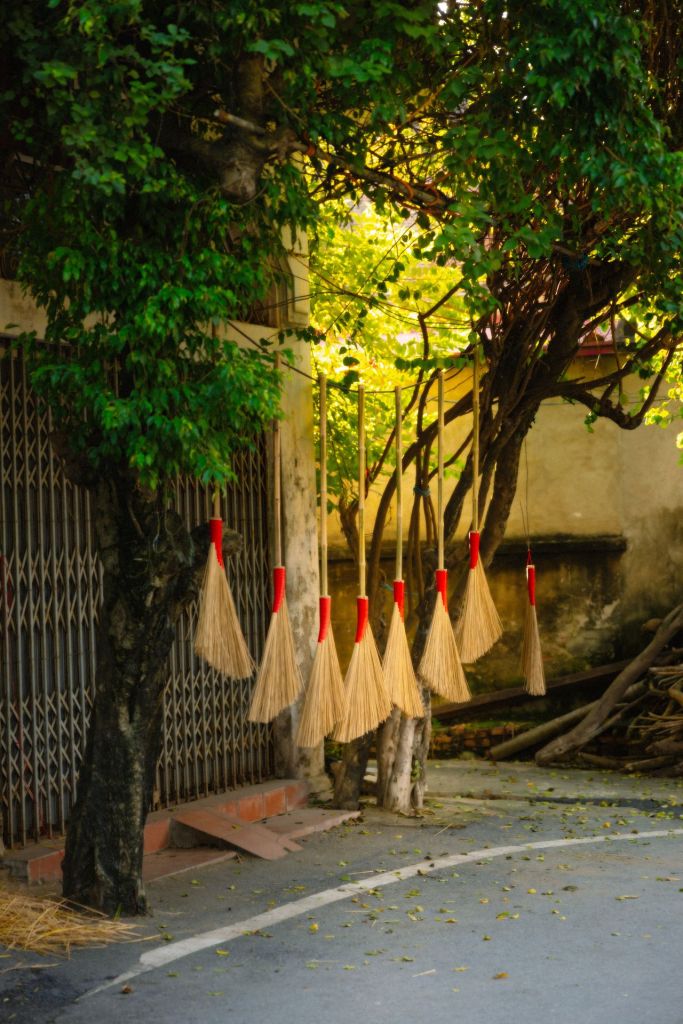
The Witch’s Broom is most probably the favourite tool of many Witches. Few objects are more immediately associated with the Witch than the broomstick.
The black-clad Witch, the pointed hat, the cauldron and the broom have become almost universal symbols of witchcraft.
The broom has a fascinating history, but it is worth separating documented folklore and historical witchcraft accusations from modern witchcraft practice.
The familiar image of the witch flying on a broom is largely an early-modern European development rather than an ancient pagan custom.
Broomsticks appear in fifteenth-century imagery of witches, and later accounts connected them with magical flight.
For the actual broom, the traditional besom was a bundle of twigs or plant material attached to a wooden handle. Brooms could be made from locally available vegetation; surviving magical examples include wood, willow bindings, reed, palm leaves, thread and foraged branches.
But the history of the broom is much older and more interesting than the familiar image suggests. The broom began as something wonderfully ordinary:
a household tool.
It swept the floor. It cleared away dirt. It created order from disorder. And perhaps that is precisely why it became such a powerful magickal symbol.
The Besom
The traditional broom used in Britain and other parts of Europe is often called a besom. A besom consists essentially of a bundle of twigs or other plant material attached to a handle.
The materials varied according to what grew locally. Birch twigs, broom, heather, willow and other flexible branches could be used for the brush, while a straight wooden branch formed the handle.
The Museum of Witchcraft and Magic has surviving examples of magickal and witchcraft-associated brooms made from wood, willow, reed, palm leaves, thread and foraged branches.
So there is no single “correct” witch’s broom. A broom made from materials gathered from your own landscape can be especially meaningful.
The forest provides the wood. The plants provide the brush. The Witch brings the intention.
How did the broom
become connected with witches?
This is where history becomes particularly fascinating. The image of witches flying on broomsticks becomes visible in European sources during the late medieval and early modern period.
One famous early example is the fifteenth-century manuscript Le Champion des Dames, whose illustrations show witches flying on broomsticks. The imagery developed in the context of European witch beliefs and witch trials.
Later European demonological literature and artwork increasingly portrayed witches flying through the air on staffs, brooms and other objects.
Some accounts also associated magical flight with so-called flying ointments. Historical sources describe alleged witches applying intoxicating or poisonous preparations before supposed supernatural journeys, although the reliability and extent of these practices are debated.
So the broomstick did not begin as an ancient pagan flying machine.
Its association with the Witch developed through a complicated mixture of folk magick, household symbolism, magickal beliefs, witch-trial testimony and early-modern artistic imagination.
Why is the broom so magickal?
For the modern Witch, the symbolism is almost perfect. A broom removes what no longer belongs. Dust is swept away. Old things are cleared.
The threshold is purified. The house becomes orderly again. Therefore the broom can become a magickal instrument of: cleansing, protection, banishing, purification and renewal.
When you sweep with a magickal broom, don’t think only about cleaning the floor. Imagine sweeping away:
fear,
stagnant energy,
arguments,
unwanted influences,
old habits,
and everything that has finished its purpose.
The broom becomes a physical representation of magickal intention.
Choosing a new Witch’s broom
When making or purchasing a new broom, choose one that feels right in your hands. It does not need to be expensive. In fact, a simple handmade besom can be much more meaningful than an elaborate decorative broom.
Look for a wooden handle that feels comfortable and balanced. For the brush, choose natural materials where possible. You might use:
birch — cleansing and renewal
willow — water, intuition and flexibility
heather — protection and the wild landscape
broom plant — naturally associated with sweeping and the old besom tradition
rowan — protection
These plant associations are part of modern magickal symbolism rather than a universal historical code. Let the plants have meaning within your own tradition.
And if you gather your own wood, do so responsibly. Never take a living branch unnecessarily. A fallen branch can carry just as much beauty.
Consecrating the new broom
beneath the Full Moon
A Full Moon is a beautiful time for consecrating a new magickal tool. There is no single historical “Full Moon broom consecration” that can be reconstructed from medieval European sources, so the following is a modern witchcraft ritual.
Place the new broom on a clean cloth. Light a candle. Place a bowl of water beside it. You can also place salt, incense or a small offering of herbs nearby.
Then sit quietly with the broom. Hold the handle with both hands. Feel its weight. Think about all the things this broom will help you remove from your life.
When the Moon is visible, raise the broom toward the moonlight. Then say:
Under the light of the Full Moon,
I awaken this broom.
May it become my tool of cleansing.
May it sweep away what harms me.
May it clear what no longer belongs.
May it guard the threshold of my home.
May it carry away fear, disorder and stagnation.
And may it leave behind peace, strength and light.
Pass the broom gently through the incense smoke if you are using incense. Then touch the handle with a little clean water.
You can sprinkle a tiny amount of salt around it, rather than directly onto the wood, if you want to include the symbolism of earth and purification.
Finally, hold the broom beneath the moonlight again and say:
Moon above, earth below,
awaken this tool and let its power grow.
By hand, by heart, by word and will,
let this broom serve my magic still.
What I sweep away shall depart.
What I protect shall remain within my heart.
Then leave the broom where it can receive the moonlight overnight.
The first sweeping
The first time you use your newly consecrated broom, don’t begin by sweeping ordinary dirt. Begin at the back of the house. Move slowly toward the front door.
As you sweep, imagine everything unwanted being gathered together and pushed toward the threshold. You can speak:
What does not belong here, depart.
What brings harm, depart.
What brings fear, depart.
What brings disorder, depart.
This home is cleansed.
This home is protected.
This home is mine.
Sweep everything symbolically toward the door. Then stop. Do not sweep the unwanted energy back into the house. Open the door and imagine it leaving.
Close the door. Now your broom has performed its first magickal task.
The broom as guardian
I also like to think of the broom as a guardian of the threshold. When it is not being used, it can be kept near the entrance of the house. The physical broom reminds the Witch:
I decide what enters.
I decide what leaves.
This makes the broom especially powerful for boundary magick. You can even tie a small cord around the handle and add a protective symbol, rune or sigil meaningful to your own practice.
And what about flying?
The broomstick’s famous ability to fly belongs primarily to the folklore and magickal imagination that developed around European witchcraft.
For the modern Witch, I prefer to understand “flying” symbolically. The broom is the vehicle of the Witch’s imagination. When you sit with it during trance or drumming, imagine travelling across the night sky.
Above the forest. Above the mountains.
The broom becomes a bridge between the ordinary world and the imaginal world. You don’t need to claim that your physical body has left the ground.
The journey can happen in consciousness during your meditation.
My blog
Here is my blog.
 LUCIFERA666