The Galdrabók is a very interesting book about Icelandic magick. There are books that tell us about magick. And then there are books that make us feel as though we have opened a door.
The Galdrabók, usually translated as The Book of Magic, is one of the most fascinating surviving Icelandic magickal manuscripts. Written in Iceland around the late sixteenth or early seventeenth century, it contains a remarkable collection of magickal instructions, prayers, invocations, charms and magickal staves.
For the modern Witch, opening the Galdrabók can feel like looking across several centuries and discovering that someone, somewhere in Iceland, was asking many of the same questions we still ask today:
How can I protect myself?
How can I overcome an enemy?
How can I find love?
How can I gain success?
How can I influence circumstances that seem beyond my control?
How can I communicate with the unseen?
But there is something important to remember before we begin.
The Galdrabók is not an ancient Viking spell-book. It comes from Christian-era Iceland, several centuries after the Viking Age.
Its magick reflects a fascinating mixture of traditions: Icelandic folk magick, Christian prayers, learned European magickal traditions, magickal alphabets, charms and practices that belong to the world of galdr.
That mixture is precisely what makes the manuscript so extraordinary.
What does “galdr” mean?
The Old Norse word galdr is associated with magickal song, chanting and incantation. Magick was not necessarily something that was silently written on a piece of parchment.
The voice could be magickal. Words could be spoken. Names could be invoked. Sounds could be repeated. A magickal formula could be sung or chanted.
This is one of the reasons I find Icelandic magic so fascinating for modern shamanic witches. There is a natural connection between voice, rhythm, breath, intention and altered states of consciousness.
A witch sitting beside a fire, chanting a magickal formula while a drum beats steadily in the background, is creating a very different experience from simply reading words from a page.
The body becomes part of the spell.
The mysterious staves
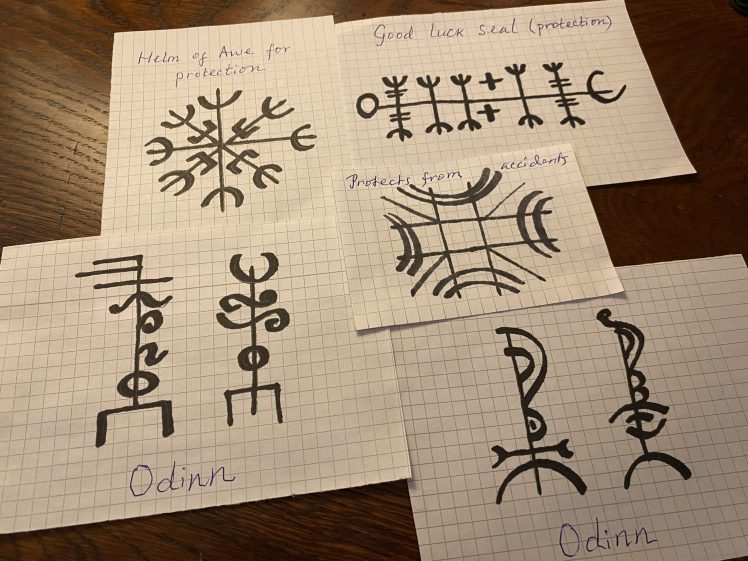
Perhaps the most famous feature of Icelandic magical manuscripts is their strange and beautiful drawings. These are the magickal staves.
Some look almost like runes. Others look like intricate wheels, crosses, branches or geometric constructions.
Some are associated with particular magickal purposes. Others are accompanied by words, names or instructions explaining how they should be used.
And this is where we should be careful. It is tempting to call every Icelandic magical stave a “sigil of a spirit.” But historically, that is not quite accurate.
Some magickal signs are associated with particular beings, names or powers, while others are functional magickal signs created for a particular purpose.
A stave might therefore be understood as part of a magickal language:
the symbol gives form to the intention,
the words give it direction,
and the ritual gives it action.
For the modern Witch, this opens fascinating possibilities. A stave can be studied historically. It can be drawn as part of meditation.
It can be incorporated into a modern talisman. It can become part of a knot spell. Or it can inspire the creation of a completely new magickal symbol.
But we should always distinguish between what the historical manuscript tells us and what we choose to do with its imagery today.
What kind of magick
is found in the Galdrabók?
The manuscript contains a surprisingly broad magical repertoire. There are spells concerned with:
protection
healing
love
victory
success
concealment
finding lost things
causing fear
dealing with enemies
and many other aspects of everyday life.
This tells us something important. Magick was not necessarily regarded as a separate activity reserved for extraordinary occasions. It could be concerned with the ordinary problems of being human:
Love, money, health, danger, travel, enemies, luck, uncertainty and fear.
The magickal practitioner wanted tools for navigating the unpredictable world. And perhaps that is why the Galdrabók still speaks to us.
The Christian elements
One of the most fascinating things about the manuscript is that its magic is not purely “pagan.”
Christian prayers and references to God, Christ, angels and biblical figures appear alongside magical signs and older magickal traditions.
For a modern reader, this can initially seem strange. We may imagine that Norse paganism and Christianity were completely separate worlds.
Historical Iceland was much more complicated. The manuscript belongs to a period when Christian religious culture had existed in Iceland for centuries, while older traditions, folklore and magickal practices continued to influence popular culture.
The result is a magical world in which Christian prayer, folk magick, magickal signs and older Norse concepts can exist on the same page. That mixture is part of the historical reality.
The Galdrabók
and the modern Witch
So how should we approach the Galdrabók today? Not as a cookbook. And not as a collection of spells that we must reproduce word for word.
I prefer to approach it as a window into the magickal imagination of Iceland. We can study the old formulas. We can examine the staves. We can learn about the plants and materials.
We can explore the relationship between spoken words and magical intention.
And then we can ask: what can this teach the modern Witch? Perhaps the greatest lesson is that magic is not simply about possessing the correct symbol.
It is about relationship. Relationship with words. Relationship with symbols. Relationship with the natural world. Relationship with the unseen. And relationship with one’s own intention.
The beginning of our journey
In the coming posts, I want to explore this world more deeply. We will look at the mysterious Icelandic magickal staves and ask what they actually mean.
We will explore some of the most fascinating examples found in Icelandic magical tradition. We will talk about galdr—the magick of the voice. We will explore the fascinating practice of knot magick.
My blog
Here is my blog.
 LUCIFERA666