The language of the Icelandic Staves: sigils, spirits, and knot spells – this is a very interesting subject. When we look at the drawings in the Galdrabók and at the magickal signs presented in Stephen E. Flowers’s Icelandic Magic, it is tempting to see them simply as mysterious symbols.
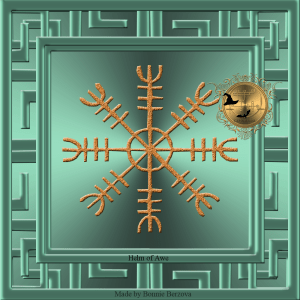
But within the Icelandic galdor tradition, the stave is more than a picture: it is a magickal sign designed to embody, direct, or activate a particular power, intention, name, or force.
There is one important nuance, however: not every stave is literally the sigil of a spirit. Some are associated with particular beings or divine names, while others are named for their function—protection, victory, sleep, concealment, love, and so on.
Flowers emphasizes that the signs can be understood as part of a magickal grammar, in which names, words, symbols, and their combinations can be used to direct magickal power. He also discusses creating personalized signs from the mythic names of Óðinn.
This gives us an interesting way to work with the staves today. A stave can be incorporated into a larger magickal construction.
Instead of using it in isolation, we can combine its symbolic force with another magickal technique—for example, a knot spell. The knot becomes the structure of the spell, while the stave becomes one of the powers woven into that structure.
Historical Icelandic material describes the stave being used in connection with facing enemies and protection from harmful forces.
In a modern knot-spell practice, we could therefore weave the intention of Ægishjálmur into the knots: each knot binding the person more firmly within a symbolic sphere of protection.
The same principle can be applied to signs connected with Óðinn. Here we should be careful with terminology: rather than claiming that a particular modern drawing is an ancient, historically attested “sigil of Óðinn,” it is more accurate to speak of a personalized magickal sign constructed from Óðinn’s names or attributes.
Flowers specifically discusses this possibility in Icelandic Magic. The important idea is that the stave is not merely decoration.
The knot binds. The word directs. The sign embodies. The intention gives the working its purpose.
Seven knots of protection
Here is a modern poetic formula that can accompany a seven-knot protection spell. Each knot can be tied while speaking one stanza, with the Ægishjálmur, an Óðinn-inspired sign, or another appropriate protective stave incorporated into the working.
First knot — the boundary
By the first knot, a circle is drawn,
Around this life from dusk to dawn.
Let danger pass and evil flee,
Let no harm cross this boundary.
Second knot — the strength
By the second knot, strength arise,
Beneath the earth and through the skies.
Let courage stand within this soul,
Unshaken, guarded, firm and whole.
Third knot — the watch
By the third knot, let watchers see,
What comes in darkness, what may be.
May hidden danger come to light,
And wisdom guide the steps aright.
Fourth knot — the Helm of Awe
By the fourth knot, Ægishjálmur stand,
A shield of power at this hand.
Let fear depart, let danger cease,
Surround this person now with peace.
Fifth knot — Óðinn’s wisdom
By the fifth knot, Óðinn’s sight,
Guide these steps through day and night.
Grant wit to know, and strength to choose,
The paths of safety, none to lose.
Sixth knot — the return
By the sixth knot, let harm turn away,
Let hostile forces lose their way.
What is not meant for this one’s door,
Shall find its path here nevermore.
Seventh knot — the seal
By the seventh knot, the work is sealed,
Sevenfold guarded, sevenfold healed.
Bound by word and sign and will,
May this protection hold steadfast still.
The historical Icelandic material gives us the vocabulary and grammar of galdor-stave magick; combining those elements with a seven-knot spell in this particular way is best understood as modern magickal practice inspired by the tradition, rather than as a claim that this exact knot ritual was performed in medieval Iceland.
That distinction actually makes the practice more interesting: we are not merely copying an old symbol—we are learning its magickal grammar and using that grammar to create a new working.
The old stave becomes the seed.
The knot becomes the binding.
The poem becomes the voice.
And intention becomes the direction of the work.
Ginfaxi
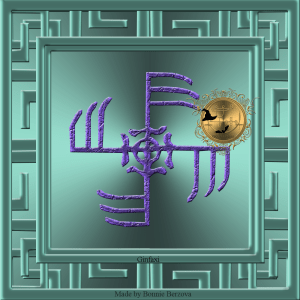
Ginfaxi is a particularly interesting stave because its historical purpose is not primarily general protection. In the Icelandic magickal tradition, Ginfaxi is paired with Gapaldur in glímagaldur—magick connected with Icelandic wrestling.
Ginfaxi was placed under the toes of the left foot, while Gapaldur was placed beneath the heel of the right foot, with the pair intended to help the practitioner prevail in the struggle.
That gives Ginfaxi a powerful symbolic meaning for modern practice: strength in struggle, the ability to withstand pressure, and the power to overcome resistance.
Ginfaxi:
the power to stand and overcome
Ginfaxi can be understood as a stave for the moments when a person finds themselves in a struggle.
Its original context was physical combat, but Flowers also presents the Gapaldur–Ginfaxi working under the broader heading of “Winning Struggles of All Kinds,” extending the symbolism beyond wrestling to internal struggles and conflicts with others.
This makes Ginfaxi particularly suitable for situations where someone needs to:
- remain strong when facing adversity;
- stand their ground when under pressure;
- overcome obstacles and resistance;
- strengthen determination and perseverance;
- maintain confidence during confrontation;
- find the inner strength to continue when circumstances become difficult.
The important distinction is that Ginfaxi is not simply a “protection symbol.” Its traditional association is more active. Protection creates a boundary around a person; Ginfaxi represents the power to meet resistance and prevail.
This also explains why it works so naturally with Gapaldur. The two staves create an almost beautifully physical magickal image: one gives stability and grounding, while the other contributes the force needed to overcome the struggle.
Historically, however, it is worth keeping the distinction clear: the surviving sources specifically connect Ginfaxi with victory in wrestling and with the paired Gapaldur–Ginfaxi working.
Extending it into a general-purpose spell for personal resilience or protection is a modern interpretation inspired by that traditional symbolism, rather than a documented medieval use.
And that distinction actually gives Ginfaxi a fascinating place alongside the Ægishjálmur: Ægishjálmur can represent the protective, awe-inspiring shield; Ginfaxi can represent the strength that allows the person behind that shield to stand their ground.
My blog
Here is my blog.

